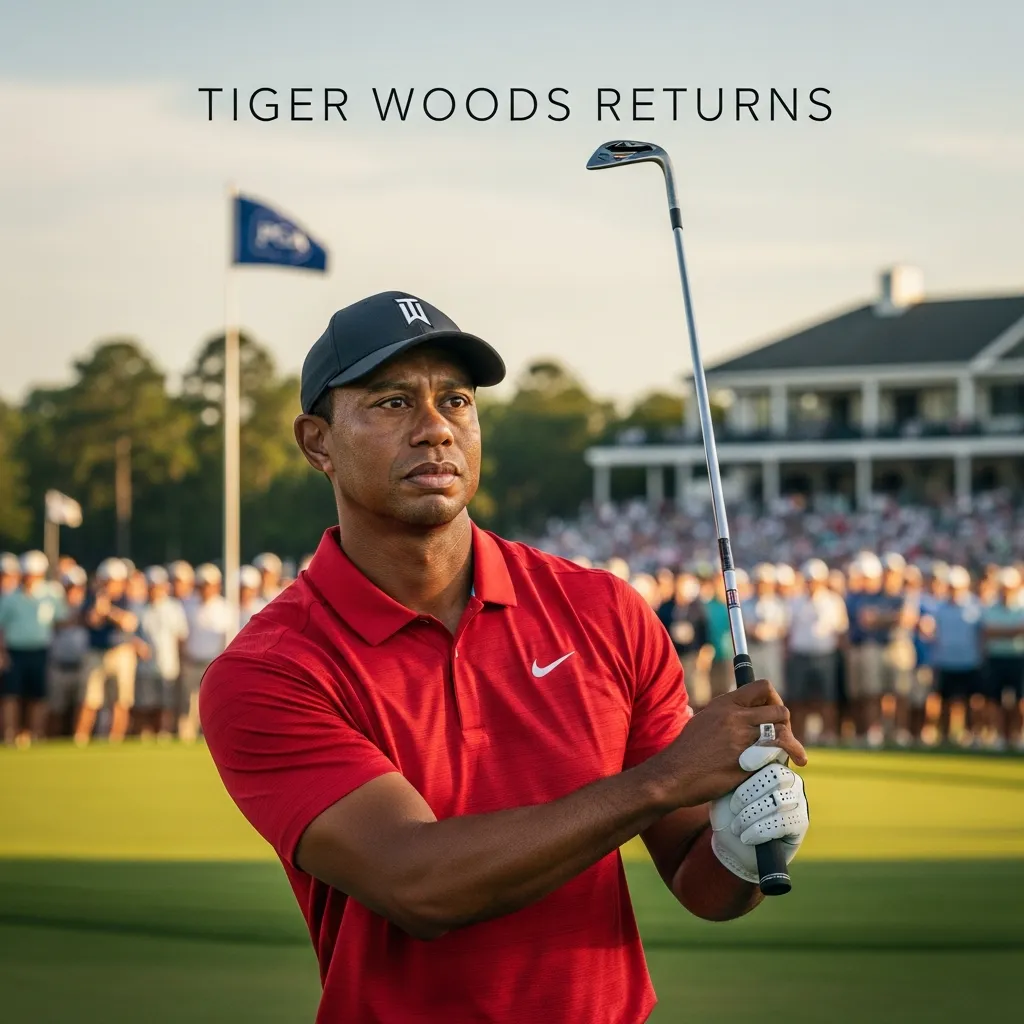
Tiger Woods Returns: First PGA Event Post-Rehab
Hollywood News, Sports, Golf, Celebrity Comebacks
Tiger Woods Steps Back Into the Spotlight: First PGA Appearance Since DUI Crash and Swiss Rehab
Tiger Woods has resurfaced in the public eye with his first PGA appearance since a devastating DUI crash and a months-long rehabilitation stay in Switzerland, forcing the sports world to confront not just the future of a legend, but the fragility of the man behind the myth.
A Return Framed by Rehab, Not Leaderboards
Woods’ latest appearance is not as a contender on the leaderboard, but as a visible presence at a PGA Tour event, his first since the March 27 rollover crash near his Florida home that led to a DUI arrest and renewed questions about his health and future. According to multiple reports, he completed an intensive rehabilitation program at a clinic in Switzerland, focusing on both physical recovery and pain management before quietly returning home in mid-June 2026.
His private jet’s landing in Palm Beach, Florida, marked the end of a difficult chapter spent largely out of public view. It also marked the beginning of another, as the 15-time major champion steps back into a world that has watched his triumphs and breakdowns with equal fascination for nearly three decades.
No Competitive Golf Since Royal Troon — And None on the Horizon
Woods, now 50, has not played competitive golf since the 2024 Open Championship at Royal Troon, a milestone that already felt like the closing of a chapter. Two years later, his competitive absence has only deepened. He has not registered for the 2026 Open Championship at Royal Birkdale, ensuring he will miss all four men’s majors for the second straight year, extending his streak of missed majors to eight in a row across the 2025 and 2026 seasons .
Analysts now estimate the probability of him teeing it up in a PGA Tour event before the end of 2026 at just 43%, a number that underscores how uncertain his playing future has become. For a sport built on his shadow, the idea that Tiger Woods may never again be a regular presence inside the ropes is no longer unthinkable — it is a scenario the game is slowly learning to accept.
Woods’ path back to competition is uncertain, but his influence still shapes every fairway.
Pain, Prescription Drugs, and a Not-Guilty Plea
The crash and subsequent arrest exposed once more the brutal physical toll that Woods’ career has taken. Following his DUI arrest, it was confirmed that he had significant physical mobility limitations and was using hydrocodone, a powerful opioid, for chronic pain. Court documents and police reports described signs of impairment, even as his breathalyzer test registered 0.00 for alcohol, placing the focus squarely on prescription medication and long-term injury management .
In Martin County Court, his lawyer entered a not-guilty plea, contesting the DUI and related misdemeanor charges while prosecutors moved to subpoena medical and prescription records. Woods was granted court approval to leave the United States to seek treatment, enabling his stay at the Swiss clinic that he has now completed. Legal proceedings continue to shadow his recovery, a reminder that even for one of sport’s most protected figures, accountability and due process still apply.
From Superstar to Steward: Influence Without a Scorecard
While his body keeps him from competing, Woods’ fingerprints are all over the sport’s future. He chairs the PGA Tour’s Future Competition Committee, a powerful group tasked with reshaping the Tour’s format and schedule in the wake of seismic shifts in professional golf. In June 2026, he appeared publicly in Cromwell, Connecticut, alongside Tour leadership to outline a sweeping new two-track structure set to debut in 2028, underscoring his evolving role from superstar to steward .
Beyond the traditional Tour, Woods also co-owns Jupiter Links GC in the tech-driven TGL league and has played for the team in its made-for-TV format. Even as injuries and legal troubles limit his starts, his name continues to anchor new ventures designed to keep golf relevant to younger audiences and global markets.
“Not a Quitter” — Stress, Vulnerability, and the Weight of Legacy
A golf source told People magazine that Woods is “not a quitter,” but added that the situation has created “a great deal of stress.” That stress is not difficult to imagine: a body rebuilt through surgeries, a legal case unfolding in public, and a legend wrestling with the possibility that his last true competitive swing may already be behind him.
Woods’ journey has always been about more than trophies. His latest chapter highlights human vulnerability in its rawest form: a global icon confronting pain, dependence on medication, and the limits of what even his iron will can overcome. Yet it also carries the familiar threads of redemption. Completing rehab, facing the courts, and choosing to remain engaged with the sport’s future suggest a man still intent on writing his own ending, even if it looks different from the one fans imagined.
What Tiger’s Story Says About All of Us
For Hollywood watchers and sports fans alike, Tiger Woods remains a singular figure — part comeback narrative, part cautionary tale. His current reality is a reminder that legacy is not just measured in majors won, but in how a person confronts failure, injury, and public scrutiny. The fairways he once dominated now serve as a backdrop for a different kind of drama: one about accountability, recovery, and the search for peace after a lifetime spent under blinding lights.
Whether he ever again contends on a Sunday back nine may matter less than how he navigates the years ahead — as a father, as a steward of the game, and as a man learning to live with both the weight and the wonder of his own legacy.
